
invocation
For the glory of God, for the deliverance of all sentient beings, and for the Hell of it, roughly in that order.
Compassion and Despair, or vice-versa
The Maṇi Kambum is a text in Tibetan, compiled from earlier sources in about the 12th or 13th c, if you believe “western” scholarship. If you prefer tradition, it is a revealed gter-ma or “treasure” text purportedly sealed or hidden in past ages and then discovered when the karmic time was right. (Gter-ma is contrasted in the tradition with bka-ma, i.e., teachings transmitted via oral or written tradition from teacher to student. It is not as if the Tibetans did not understand the difference!) In the case of the Maṇi Kambum, different portions were ostensibly found under or inside a couple of temple statues; the texts found include poetry and prose meditative and ritual instructions, and, most pertinent for my purposes here, an expansion on the story of the Bodhisattva Avalokiteshvara.
It is probably impossible to over-emphasize the significance of Avalokiteshvara for Tibetan Buddhism. Named Chenrezig in Tibet (the name Avalokiteshvara is a Sanskrit compound: it means, roughly, either “the Lord who gazes down upon the world,” or, alternatively, “upon the sounds [of distress]” — i.e., the distress of suffering; Chenrezig is simply an approximate translation), this Bodhisattva is identified both with Tibet itself (as its protecting patron), and with infinite compassion. The lineage of the Dalai Lamas is considered to be a manifestation of Avalokiteshvara, as was Songtsen Gampo, the first Buddhist ruler of Tibet, establisher of the Tibetan Empire, and reputed author of the Maṇi Kambum.
The twenty-fifth chapter of the Lotus Sutra, which might be the earliest text to expound upon Avalokiteshvara’s mercies, is full of superlatives. It explains, first in prose and then in verse, that calling once upon Avalokiteshvara can get you more bang for your prayer than invoking all the other Buddhas and Bodhisattvas combined, even if you invoke each one of them as many times as there are sandgrains in the Ganges riverbed. You can be saved from being burned to death by murderers, drowned in a flood, blown away by a tempest, or crushed by a falling mountain; not even a pore of your body will be hurt. Crowds of persecutors will become your friends and your would-be executioner’s weapon will fall apart. Just knowing someone — even just being arguably in the same abstract set as someone — who invokes Avalokiteshvara is to your decided advantage; if a quintillion-person expedition, in the course of seeking gold, jewels, and coral, gets stranded on an island full of ferocious rakshasis (a particularly fierce race, often antagonists in such epics as the Mahabharata), and a single person invokes Avalokiteshvara, everyone will escape.
The Lotus Sutra is thus eloquent on the power and the compassion of Avalokiteshvara, but one must turn elsewhere for an account of how this figure came by this astonishing salvific potency; for instance, to the Mani Kambum. (I take several details in what follows from a relatively recent commentary by Shangpa Rinpoche.) Avalokiteshvara is said to have been born miraculously from a large white lotus, in response to a king’s devotional sacrifices aspiring to receive a son. He wept for the suffering of the countless inhabitants of the six realms. One day (I am compressing somewhat, it will be perceived), at a sacrifice, he recollected the divine mission for which he had become incarnate. He realized, regarding sentient beings: “their desires are like the waterfall; their hatred is like a blazing fire; their ignorance shrouding them like clouds of darkness; their pride is as solid as the mountain, and their jealousy is as rapid as the wind.” (Note how these elemental characterizations recapitulate all those threats that the Lotus Sutra tells you will become harmless — the fire into which the murderer might drop you, the mountain which might drop on you. They are simply synecdoches for the passions of sentient beings.) Avalokiteshvara swore to deliver them all without exception, and Amitabha Buddha instructed him in the particulars of the Bodhisattva vow. “To benefit all, your motives must be compassion and kindness. Do not weary; do not surrender to despair!” Avalokiteshvara resolved: “from my every pore, let me send Buddhas and bodhisattvas responding to the needs of every sentient being. May I free them all without exception.” And then, in what would prove to be a fateful moment, he added this clause to his oath: “Should I for a moment cling to self, let my head break in pieces.”
Avalokiteshvara sent out six emanations into the six realms (including Sakyamuni Buddha into our earthly realm), and by the teaching and skillful means of these emanations, countless sentient beings found release from suffering. After a long time (bear in mind, when a Tibetan Buddhist text says “a long time,” it is usually thinking not in years nor in millennia but in kalpas), he took stock. To his surprise, the realms still teemed with sentient beings mired in suffering. So he again manifested six pure dharma teachers in the six realms, and waited another, similar span — with the same success, or lack thereof. A third trial was likewise without appreciable results — for although countless sentient beings had attained deliverance, the cosmos was still full of suffering, indeed no less full than before. After the fourth such attempt — we are now reckoning in spans of time far exceeding the total expected lifetime of the universe by modern cosmological accounts — Avalokiteshvara was filled with dismay. “The Tathagatha has said: space is infinite; and so too are sentient beings and their suffering. Though I have freed countless such sentient beings, they remain as many, and their suffering as great, as before. There is no end to Samsara. It is myself I must free.”
Upon this transgression of his vow, Avalokiteshvara’s head was shattered.
Meta-Riffs on a Broadway riff on a Chagall
Fiddler on the Roof is a Broadway musical and a Hollywood film. For a long while it held the Broadway record for the longest continual run of any musical (having edged out Hello Dolly!), until it was in turn displaced by Grease. Nothing lasts forever. Which was, arguably, the theme of the play itself, which famously posed the life of “tradition” against the inexorable forces of modernity: not only the industrial, economic and social trends that were changing social mores, but also the forces — the no less irrational but darker — of political animus (politics which as Comrade Trotsky reminded us, “is interested in you” even (especially) if you do not repay the favor), which would eventually target the Jews in a new wave of pogroms. “Tradition” — the title of Fiddler’s opening “big number” — is arguably the most important word in the script, but it gets this importance precisely by being challenged, rebutted, and inevitably diminished. One way to regard the show, indeed, is as a kind of summary of the wistful nostalgia or even bad conscience with which modern liberalism regards the traditions it has displaced, the traditions whose overt “justification” might have been the circular “it is a tradition,” but which liberalism cannot help but worry knew something — on some inarticulate and perhaps inarticulable level — that liberalism does not know and therefore cannot provide.
This play was originally based1, as used to be more widely known, on a number of stories by Solomon Naumovich Rabinovich, one of the most prolific writers of Yiddish literature at the beginning of the twentieth century. Rabinovich was also (and better) known as Sholem Aleichem, the Yiddish phrase (meaning “peace be with you”) he adopted as nom de plume. (This alias in his own lifetime provoked comparisons with his contemporary Mark Twain. Personally, I think of O. Henry.) Fiddler was named, on the other hand, after a painting — no one is quite clear on which — by Marc Chagall, one of a small number Chagall painted which features this odd figure, a violin-player sitting or standing on, or floating slightly above, the roof of a house. “Sounds crazy, no?” asks the opening monologue by the character who dominates the entire show, Tevye the Dairyman, answering the meta-question that the script does not overtly ask: Why is the play called this? Tevye says that “every one of us” in his little village could be called such a fiddler, “trying to scratch out a pleasant, simple tune, without breaking his neck; it isn’t easy.” But, he goes on: “we stay up there,” despite the obvious danger, because the village is “our home” — an answer that does not quite answer; and “we keep our balance” via — “Tradition.”
In the Aleichem stories behind Fiddler, Tevye — one of a long galumphing line of tragicomic figures from the picaresque, from Apulieus’ Golden Ass, through the rogue Abu al-Fath al-Iskandari and some of Chaucer’s goofballs, to Ignatius J. Reilly — is given to long internal monologues of worldly “wisdom” (of a sort), complaint and resignation and such, meandering from one point to another, touching down frequently enough in tropes from the Synagogue or the Shule, but remaining earthy and canny and idiosyncratic. Strictly speaking, the whole series of stories is a monologue, or a set thereof, since Tevye is always the narrator and each tale is presented as his apparently rambling account of some episode (told to the listening “Mr. Sholem Aleichem”). Tevye is grounded, after a fashion — not always articulately, not always accurately — in “tradition,” frequently (mis)quoting “the Good Book;” but he is also a practical man, and more than practical; he knows — again partly inarticulately — that modernity is indeed bearing down upon the shtetl.
This motif of the salt-of-the-earth fellow “philosophizing” is a well-established feature of the picaresque: think for instance of the back-and-forth between Sancho and Don Quixote. In Aleichem’s stories, one does indeed find Tevye musing in just this fashion, weighing alternatives and persuading himself, as for instance here in a passage from the first of the tales, “Tevye Strikes It Rich”:
“How much longer can I keep on toiling and moiling from dawn until dark? Day in and day out — the same horse and wagon, night and day the same butter and cheese? It’s time, Tevye, that you took a little rest, became a man among men, went into the Synagogue once in a while, turned the pages of a holy book. Why not?” Then Tevye raises a question — a question the form of which I think Aleichem could not have known would have the staying power it has shown: “And on the other hand, if I lose out, I should fall buttered side down?”
Tevye is quick to dismiss the thought: “Better not think of that.” But a note has entered into the text that, as the story gets refolded from one permutation to another, will become an entire theme.
In Aleichem, the phrase “on the other hand,2” from the end of the passage just quoted, is one incidental bit of Tevye’s musing; it recurs from time to time in the stories, but it does not seem to constitute a motif (and the italics in the above quotation are mine not Aleichem’s). To be sure, Tevye does indeed hem and haw and oscillate, before he comes down in one place or another; but while Aleichem shows this, he does not seem to mean to make the specific words “on the other hand” into Tevye’s signature. In Fiddler on the Roof, however, this phrase becomes a shtick unto itself. This is probably a feature of the necessary condensing of a character with “a few broad strokes,” as they say; a function of compressing a long reading experience into two hours onstage. (A similar upping-the ante happens, for instance, with Sancho’s deployment of proverbs from Don Quixote to its Broadway “adaptation” Man of La Mancha). But the effectiveness of this compression is undeniable. Tevye’s personality dominates the whole script of Fiddler, but there are certain moments when Tevye’s inner monologue becomes explicitly dramatized for the audience — the action freezes and we see Tevye dispute with himself and/or with God — and these episodes, like the musical numbers, tend to be those which viewers of the film, at any rate, remember. They stand out because, like the songs, they have a structure, a device which is repeated and so punctuates the narrative with a mnemonic force. In each of these moments (there are four in the movie), Tevye is shown weighing alternatives (each time regarding marriage proposals — or on one fateful occasion, the fait accompli of marriage — to one of his three elder daughters, Tzeitel, Hodel, and Chava), back and forth, meditating with the phrase “On the other hand…”
The first two times, Tevye considers suitors for his eldest daughter Tzeitel — first, his rich neighbor, and then the impoverished tailor Motl whom Tzeitel favors. “What kind of match would that be, with a poor tailor…? On the other hand, he's an honest, hard worker… On the other hand, he has absolutely nothing… On the other hand, things could never get worse for him, they could only get better….” This being the comic upswing of the show, Tevye ultimately approves the match between Tzeitel and Motl, though it bucks tradition that his daughter and her fiance have given each other their pledge rather than accepting the pairing proposed by the village matchmaker.
After this, it is Hodel’s suitor Perchik, with his revolutionary politics (Hodel will later follow Perchik to a Siberian labor camp); Tevye again relents despite the young couple’s asking solely for his blessing and, explicitly, not for his permission (though he saves face by “giving” both).
Finally and fatefully, Tevye is tested by his daughter Chava’s love for someone beyond the community — Fyedka, a Christian. And this last strains Tevye’s flexibility too far. Knowing Tevye’s opposition — he has forbidden her to see Fyedka again — Chava marries anyway, and comes to beg her father to accept them. “How?”, he asks himself. “How can I accept them? Can I deny everything I believe in? On the other hand — can I deny my own daughter? … On the other hand — how can I turn my back on my faith? My people? If I try and bend that far, I'll break! On the other hand... No — there is no other hand!” It is one of the heartbreaking scenes3 in modern American theater. From then on, as per strict observance, Chava is “dead to” Tevye, and as far as he is concerned, to the rest of the family as well. “There is no other hand.” Chava sobs as Tevye walks away from her, pretending he does not hear.
Shameless whataboutism
Why have I dwelt on this little motif from “the world’s most beloved Broadway musical” at such length? Because (and I am aware that this may be regarded a peculiar reason) it has to do with my pedagogy. I am by profession and vocation an educator; I have a very modest (and to be frank, precarious) foothold in a small niche in the ecosystem of schooling, among students mostly between the ages of 10 and 16 years, who I “teach” philosophy; by which I mean, I simply philosophize with them. There are no lessons — certainly no “doctrines” — one can impart; there is only the lived experience of perplexity (and, occasionally and temporarily, insight). If anything, I try to let them teach themselves (like Ranciere’s “ignorant schoolmaster”); theirs are the questions we take up. What I do is show them what it can mean to take a question seriously, and, if I can put it thus, to be taken seriously by a question. This is not a performance. Nor am I suspending my “beliefs” for the sake of the conversation. It is often a question of leaning into one’s beliefs far enough and hard enough to discover that they have hidden implications, resonances, and liabilities. I can do this because I know how to be taken by surprise4. One of my few real talents is knowing how to be bemused, befuddled, at times, even dumbfounded. And one of the best, simplest, and (for me anyway) most natural ways I know how to do this is by seriously entering into the spirit of Tevye the milkman: On the other hand….
As all of my students have been reminded many times, there is always something more, something contrasting, to be said; an objection to be raised and parried, a qualification or clarification to be added, a mistake (or the appearance of one) to be guarded against. “So then, what about — ?” “All that may be so, but then how does one account for — ?” “Yes, OK, but on the other hand —.” This can be summarized in an image: the philosopher has an indefinite number of hands.
When I try to explain this aspect of my “method,” some people are amused; a few are appreciative, or act like it. Others are skeptical. And some are hostile.
But, but, but, I can imagine such a one saying — first of all, didn’t you just say that Tevye ran up against his situation in which “there is no other hand”? And secondly — fine, so you can weigh one thing and another and another. Go ahead, introduce your Exhibits A, B, C, D, all the way through Zed. So what? Is this what you have to show your students: “Ah, but you can always raise yet another question!” This is what you have to offer — liberalism, both-sidesism, all-sidesism? Please! Some of us are worried about actual problems, you know. Climate change? Are you going to tell me you try to provide a “fair and balanced” account that just “teaches the controversy?” Do you tell them that “on the other hand,” some people believe the Earth is flat? (No, they already know this, and yes indeed, we do talk about it.)
As for Tevye, we will come back to him (also to Avalokiteshvara). But to address the second and more substantial objection — let’s begin by noting that raising this question is not a confounding of the practice, but a demonstration of it. That is, you can put it into this form: OK, Yes, it’s good to notice that there are lots of times when there is much to be said about more than one side of a complicated issue, but on the other hand, isn’t there a time to cut the crap, rule some things out, and come to a decision?
I’m going to offer an answer to this question, but we will have to go the long way around. So for now, let’s ask about this “liberalism” which is thus collapsed (or is it inflated?) into “all-sidesism.” I know it is quite the thing these days (in some circles) to scoff at liberalism. Or, in other circles, to leap to its defense. (See what I did there.) This is the case even if, or perhaps above all when and because, one has not settled upon which, of many competing accounts and definitions of this vexed term, one is using. But who needs a definition when we have a list of complaints? After all: the mess liberalism (whatever it is) has landed us in! And I myself can be deeply sympathetic to this case for the prosecution — indeed (as befits a liberal, or even a fellow-traveler like me), to more than one case. At the end of the day, I am not a liberal — but while the day lasts, I know that I certainly look almost exactly like one version or another of one, not least to myself, and I take this resemblance to be not just accidental but probably indicative.
This resemblance is particularly keen when I am confronting certain versions of anti-liberalism, versions — and not the most subtle — that are more loudly asserting themselves recently. (Whatever you are thinking of when you read this — maybe Oh he means Wokeness; or, Oh he means Populism — you might be right, you might not. Fair warning.) I have watched with increasing dismay for a twenty-five years the accelerating collapse of people’s capacity to have a real conversation over differences, without casting the other person as enemy. This bizarre trigger-happy drift, what has been increasingly called “polarization,” is not the creature of Donald Trump or #BLM or whoever your particular political boogeyman is; it is your having a political boogeyman at all, your having a slot that needs to be filled by the villain de jour. “Polarization” has been growing over my entire lifetime (I have passed my half-century mark some years ago), and pre-dates me by at least a good couple of decades, as anyone will know who has read even Wikipedia articles on Cold War era episodes — e.g., Alger Hiss, the Rosenberg case, or the rise and fall of Senator Joseph McCarthy. One watershed that went largely unnoted in the media, because it was the media which committed it, was the late-90’s normalization of talk of “red” and “blue” states, permanently (though lazily) sealed into place with coverage of the 2000 presidential election; a stupid reduction of the mishmash of national subcultures in the United States of America to a preschool-level binary mnemonic. If you equate my critique of polarization with some insouciance about any particular figure, let alone about the idea of such a figure, you will have seriously misjudged the case. It is perfectly possible to believe that an idea is wrong or even pernicious, that its champions are misguided or even malevolent, and that one such pernicious idea is the notion that such pernicious ideas are all those beyond a particular very narrow band of the familiar (or, alternatively, the new and shiny — but of course from familiar and trusted “sources.”)
I am not especially worked up over the “politics,” if that’s what you call the grotesque vandalism of public consciousness and conversation with snark, self-congratulation, deer-in-headlights panic response, and mutual contempt which characterize “the national discourse” from the establishment media to whatever online comments section. But I am concerned with philosophy, and keeping it available5. There is a contemporary casualness about freedom of expression, and limitations upon it, so long as these limitations are thought to impact only “the” “other side,” which I consider unreflective at best, and — well before we get to “worst” — ill-advised to the point of stupidity. Such insouciance may have once worked just fine in smaller communities where business-as-usual could be maintained by a kind of condescending performative tolerance for those who were not in the majority, and who knew it and “knew their place”; but in a land with an oscillating 45-55% (or less) spread between positions that regard one another not as folk with some funny ideas but as saboteurs, moral idiots, and monsters of entitlement, my bet is it’s going to be catastrophic for civil society. At the very least, my friends, I assure you you will miss due process when it’s gone. But the rot has already set in when we have reified “sides” to the extent that they are no longer seen as sides of the same society. I would certainly like to avoid all of the various catastrophes that loom, or at least the crash-landing versions thereof; but my main concern is not about that at all, but about the much more specialized danger posed by these threatened catastrophes to the examined life, the life worth living. I want to safeguard that through whatever landing, soft- or crash-, may come. My inspirations are Wang Bi and Boethius, two figures who in their respective circumstances labored to transmit the heritage and the resources of their traditions through perilous historical bottlenecks (Wang Bi, during the collapse of the Han Dynasty; Boethius, during the long decline of the Western Roman Empire under the Goths. Yes, my seat-of-the-pants take is that we are in roughly analogous straits.) My own capacities and talents being what they are, all I can do is go around lighting the fire in as many places as I can, hoping it will take.
To that end, I do indeed preach the virtues of asking about “the other hand.” Philosophy, a term I have been told I fetishize, is simply the practice of trying to take the measure of the whole, (a more paradoxical endeavor than it sounds), which means it must continually be outflanking itself. It asks whether something has not after all been left out of account. This means it must start with accounts that are already lying about (yes, philosophers are “historically situated”), and then it asks — well, but what about this? What about that? Sometimes “this” and “that” can get easily put into the account we began with. Sometimes less easily, but we manage. “Managing” means shifting some term, expanding it, making a distinction, inventing a new word for a phenomenon we have precisely not invented but seen. Are we sure we’ve seen it? What if it’s just an illusion? What does it look like from over here? What about here? And then there are rival accounts, which are also lying around, which point out other phenomena with other terms. Can these be put together? Does one account easily absorb the other, or do they “complement” each other, fitting together — and if so, how? Is there a gap between them? What is being left out? What about this — ?
My tools comprise a carefully curated suite of desperate measures
When Avalokiteshvara’s resolve wavered and he considered renouncing his vow and finding Nirvana for himself, his head broke into fragments. Some say ten, some say eleven, some say a hundred or a thousand. His cries of distress and repentance reached Amitabha Buddha, who came to him, gathered the pieces of his head, and formed them into new heads: three tiers of three faces each, all with serene and gentle appearance, crowned with one head of wrathful appearance for those cases in which tough love is required; and finally atop them all, his own countenance, making eleven faces in total. Amitabha encouraged him to renew his work for the benefit of all sentient beings: “There is no beginning to samsara. There is also no end to samsara. You must benefit sentient beings until samsara ends.”
In this essay I have paraphrased many passages from Shangpa Rinpoche’s commentary, but I am copying this sentence, to underscore the paradoxicality of this instruction: There is no end to samsara, and you must keep at your work until the end of samsara. Quite strikingly, Avalokiteshvara does not respond by pointing out the strangeness of this demand; he simply makes a further request. He asks Amitabha to please, in that case, grant him a thousand eyes and a thousand arms; eyes, so as to be able to see immediately and everywhere in every corner of every realm of the cosmos, and arms, so as to be always able to act with precisely the skillful means needful to alleviate every particular case of suffering and bring about deliverance from samsara in each specific circumstance. Amitabha granted his wish, and bestowed on him a thousand arms, and a thousand eyes, one in the palm of each hand.
Avalokiteshvara, like many figures from the palimpsest of legend, devotion, and iconography that is the religious imagination in general, has numerous and various representations, but it’s this one that speaks most strongly to me: thousand-armed, thousand-eyed (well, 1,022 actually); a tall, slender figure with his calm faces, one frontal and two in profile, atop which scowls the wrathful face which then wears the serene face of Amitabha like a topknot. From either side his shoulders flower into multiple arms, displaying what is effectively a fanning peacock’s tail, a penumbra of hands, each one revealing an eye in the palm.
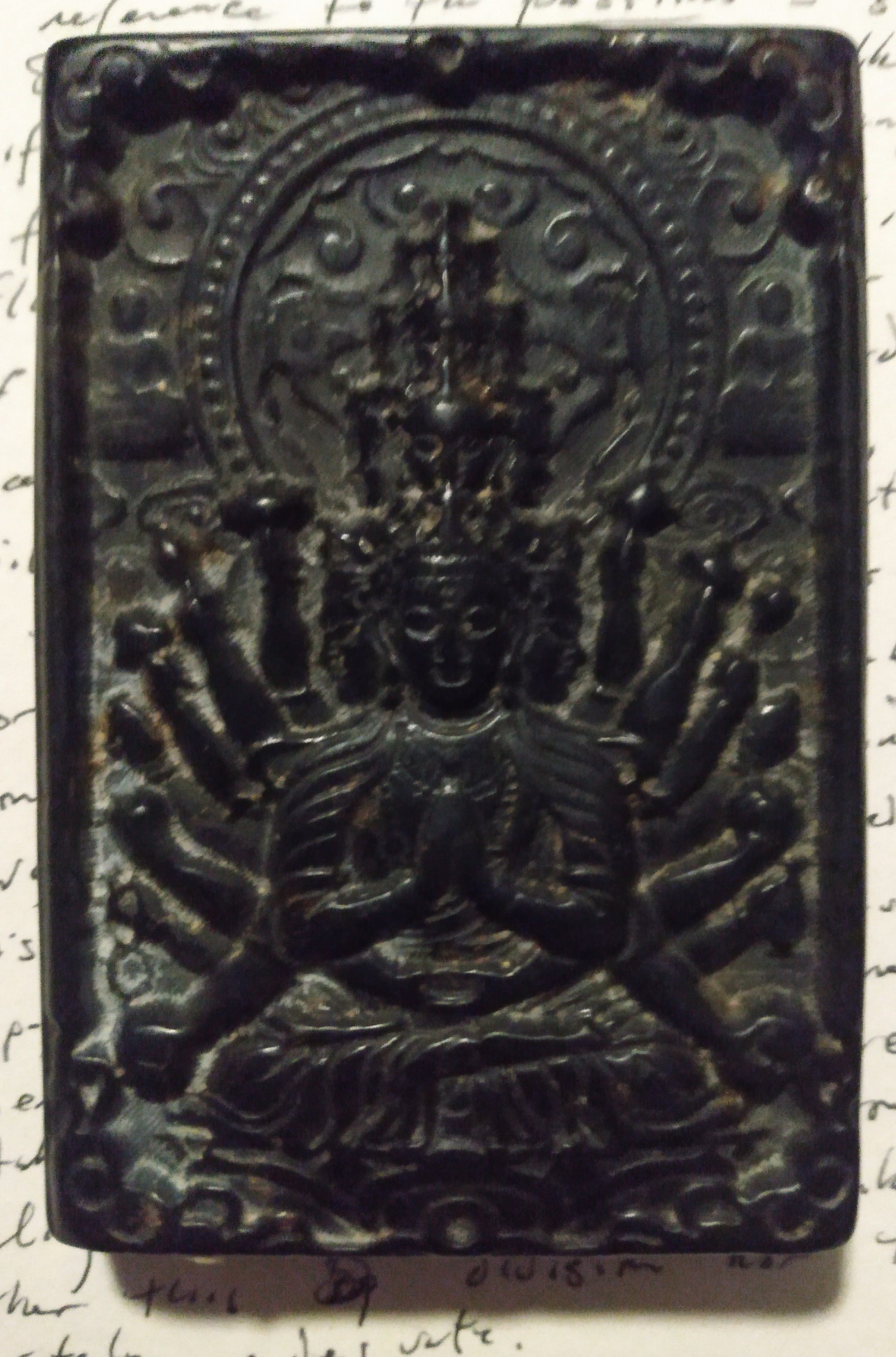
The appeal to me will be obvious: this depiction of Avalokiteshvara is the embodiment of the principle that there is always another hand.
Fine, you may say; it’s nice that you have a Bodhisattva you can kinda-sorta use as a mascot, but whatever the relevance or lack thereof of this culturally-appropriated symbol (and we’ll skip the cultural-appropriation angle for the moment though don’t think we’ve forgotten6), this doesn’t address the question about coming to the point. You still haven’t said whether you, you know, come down anywhere about whether the Earth is round, whether Vaccines Are Safe And Effective, about whether you should always or even ever pull the little kid out of the pond if they’re drowning. If all you have to offer is this endless Hmmmm, stroking your one wrathful and ten serene chins, this On-The-Other-Hand-ism really is just more liberalism of the worst kind.
Further posts are (I intend) going to try to spell out a qualified defense of some forms of liberalism from this attack upon it as mealy-mouthed or as nothing but a rationalization of the status quo. But for now I will observe that the objection misses the point of the Avalokiteshvara story. Avalokiteshvara does not receive “a thousand” (which is of course a standard trope for “indefinite number of”) hands in order to keep counting finer and finer degrees of nuance. The hands are his, the better to execute whatever skillful means will effectuate the deliverance of any given sentient being from samsara. They are not emblems of cleverness, powerful intellection, or even dialectical subtlety, no matter how prized these may be (and they are) in Buddhist philosophy; the thousand hands are a gift in response to Avalokiteshvara’s compassion for suffering, his repentance after despair, and his reverent devotion to Amitabha Buddha. This other-hand-ism is about as far from abstraction as you can get.
On not letting your one hand know what your other 999 are doing
This brings me back to Tevye the Dairyman. The end of Fiddler on the Roof finds all the Jews of the village expelled in a pogrom. Chava and Fyedka come to tell Chava’s family that they, too, are leaving, in solidarity. As Tzeitel (ignoring her father’s insistence that Chava is “dead to them”) bids her sister farewell, Tevye says — quietly enough to sound as if he is speaking to himself, loudly enough to be overheard by everyone, and in particular for Tzeitel to hear and repeat — “and God be with you.” It has taken the extremity of the loss of their home for Tevye to discover that there is still an “other hand.”
This scene from the Broadway show is one of the most different from the source material. In Aleichem’s stories, the expulsion from the village comes at the very end, after the deaths of Tevye’s wife Golde, a son-in-law (Motl, who married Tzeitel), a daughter (Shprintze, who does not figure significantly in Fiddler, who drowns herself) — in other words, after what is already a long line of sorrows. Tevye steadying himself to make the best of the catastrophe, is preparing to leave, when Tzeitel breaks down over the thought of departing from Chava. Tevye remonstrates: Chava is “dead,” how many times does he need to say it? Tzeitel says no: Chava is in the next room, and hasn’t Tevye often said that God forgives the repentant? Chava appears in the doorway and says her one line in the story: “Father.”
This occasions one of the scenes in which Aleichem shows Tevye’s reckoning most expressly. He weighs the anguish he felt when Chava disobeyed him, against the tremendous surge of parental affection he feels now. He weighs his duty as a father against his duty as a faithful Jew, and Tzeitel’s arguments against his wounded pride. Then the weighing stops; whether there is another hand or not, Tevye makes a decision. And here Aleichem is at his canniest; he does not tell us — he has Tevye not tell us — what he decides. The revealing / concealing sentence, in English (I cannot read Yiddish), says: “Put yourself in Tevye’s place; tell me what you would have done.” Thus Aleichem makes the reader re-enact the same dialectic. Again the motion — “on the other hand” — is not an endless seesaw. But the resolution could never be honestly arrived at were it not for the question; and, crucially, the final balance is left unspecified, even though we know it have been reached.7
In his posthumously published volume Angels Fear, edited and completed by his daughter Mary Catherine Bateson, there is a chapter by Gregory Bateson called “Let Not Thy Left Hand Know.” The phrase comes from the enjoinment of Jesus in the Gospels to give charity with such extreme discretion that not even “thy left hand know[s] what thy right hand doeth.” Bateson’s point is that there are occasions when the unequal distribution of information is crucial for felicitous accomplishment; one of his central examples is an episode in The Rime of the Ancient Mariner, in which the titular Mariner relates how, cursed for his perverse shooting of the mysterious heaven-sent albatross, he and his ship have come into distant waters — he alone left alive, all his crew-mates lying dead on the deck, their faces still holding the terrible expressions with which they last fixed their look upon him. Around his neck still hangs the albatross which the crew had tied there, a mark of his shame. The Mariner, who knows very well it is his own sin which has brought him and all the crew to this pass, tries to pray;
But or ever a prayer had gusht, / A wicked whisper came, and made / My heart as dry as dust.
He looks over the side of the boat and sees, flashing in the sea, the roiling motion of sea-snakes, which dazzle him, their scales flashing like fire. Though the Mariner is thirsty and weary unto death, he is momentarily moved by this gorgeous display of beauty and life, and momentarily forgets his misery. Gazing at the water snakes,
A spring of love gushed from my heart, / And I blessed them unaware: / Sure my kind saint took pity on me, / And I blessed them unaware.
He “bless[es] them unaware” — that is, without knowing what he is doing. As soon as he does so,
The self-same moment I could pray; / And from my neck so free / The Albatross fell off, and sank / Like lead into the sea.
Bateson does not put it this way, but his analysis could be summed up as: Coleridge knows what he is doing, when he has the Mariner not know what he is doing. Why, Bateson asks, must the Mariner bless the water-snakes “unaware”? Because you cannot manipulate repentance, might be the short answer. When the Mariner tries to pray, he gets only “a wicked whisper.” When he responds to the beauty of the snakes, which have nothing to do with him, something is unlocked and he finds himself able to pray. It is not the accomplishment of his redemption, it is only a beginning; but the decisive obstacle has been overcome.
Well, a dozen or more objections could be raised here: are we not, perhaps, fetishizing “spontaneity”? Or: maybe the water-snakes aren’t beautiful at all, maybe they’re horrifying, and “bless” is just a psychic swerve on Coleridge’s part. (This is Camille Paglia’s interpretation, incidentally.) Or: sorry, what does The Rime of the Ancient Mariner have to do with anything here anyway? But all of these questions are again instances of someone saying What About? On the other hand — .
Bateson is reminding us that deliberation is never the whole story. At some point, as Wittgenstein says, “explanation comes to an end,” and so does the weighing of options. Could they “theoretically” go on? Another step, another ten, another hundred and fifty-three? Sure. Another googolplex? Graham’s number? TREE(3)? What would that even mean, to be refining whether to use almond milk or soy with considerations outnumbering the quarks in the universe according to standard cosmological models? Strange but true: it seems easier to say and understand “this could go on forever” than “this could go on for [Graham’s number]8 of iterations.”
“Manipulation,” of course, literally means “handling,” i.e., being moved and maneuvered by hand; it is exactly what Avalokiteshvara wanted to be able to do in every case of suffering undergone by any sentient being. And each time, per hypothesis, there is some best answer. But this means precisely not using all the rest of the answers. Why, then, did I say above that “you cannot manipulate repentance”? For this turns out to be, maybe, both true and false. The Mariner says of the moment that makes him able to bless the water-snakes, “Sure my kind saint took pity on me;” i.e., he attributes to his saint, his patron watching over him, some agency and some intervention, into the Mariner’s own heart, that makes the Mariner capable of this, able to assent to this “spring of love.” The Mariner does not bring it about; but he still speaks of it as if it had been brought about.
Tevye, for his part, comes to a conclusion, either on Broadway or in print, but he does so by deftly not letting on what he is doing. Does he really “not know”? Is this is a betrayal of the Socratic aspiration to live up to Delphi’s injunction Gnothi seauton? Or is it a way to fulfill it? Of course, Tevye has nothing to do with the Delphic injunction at all, one might say — nothing direct, in any case; — but I do, I, who have undertaken to live and teach philosophy and who have found in this figure from Yiddish literature one of my teachers. Well, one repays a teacher badly by remaining always a student, another of my teachers said9.
I am opening this substack under the patronage of the kind saints, Avalokiteshvara and Tevye, teachers of the mantra On the other hand, because everything that I am going to offer herein will look at first like inconclusive musings; but none of them are intended to simply be the whirrings of a perpetual motion machine. I have also invoked several other names, and that too will be par for the course. There are “conclusions” to draw, if you like that sort of thing; and if you want to keep going, another step, another hundred or hundred-thousand, another however-many, you can do that too. The way up and the way down are the same way, I am reliably informed. These installments will be infrequent, if the length of time this one has taken is indicative. None of them will be much more conclusive than this one. One has to know that one does not know. And if, as per Aristotle, “the soul is in some wise all things,”10 then any ignorance is self-ignorance. The wager of philosophy is that if one can know that, one can parlay it into the life worth living.
I say “originally” because the line of descent is more complicated; Aleichem himself adapted the Tevye stories for the theater (his version did not debut — in Yiddish — until three years after his death); and another stage version by Arnold Perl had been well-received in 1957. When Jerry Bock, Sheldon Harnick, and Joseph Stein wrote Fiddler, they were scrupulous about crediting Perl (for years — possibly even now for all I know, though Perl is dead — productions specify, “with permission of Arnold Perl.”)
This phrase (dating in English to sometime in the early 17th century, according to the etymological resources I could access), connotes the introduction of an argument or assertion which contrasts to what has been said immediately prior. (I had been going to simply assume that the meaning and use of this idiom was understood, until I realized this hardly goes without saying. I suppose neither does the meaning of “it goes without saying,” but one must stop somewhere, which is also the point of this post.)
Pronouncements like this are dangerous; if you aren’t so moved, you might just roll your eyes. One thinks of Wilde’s ostensible remark about Dickens: “one must have a heart of stone to read the death of little Nell without laughing.” But since the whole gist of this post is that the heart and the mind are one force with two (at least) accents, I leave it.
I would not claim expertise in this, the way Socrates claimed to be an expert regarding Eros, but I think I have put in enough hours to claim a kind of journeyman status. These are fuzzy categories.
I almost wrote “keeping it possible,” but this would have been a mistake, and strictly speaking keeping philosophy possible is beyond me. Philosophy is thinking that aspires to a whole and absolute validity, moved by concern with truth alone, with the complete truth, and the truth rightly put and ordered. (If you are noticing a semi-resonance with a certain well-known legal formula concerning sworn testimony, as featured in probably thousands of Hollywood and television “courtroom dramas,” and tracing back to the 12th century or earlier, you are noticing something real.) This means philosophy aspires to be unconstrained by historical moment or cultural circumstance, regardless of the philosopher’s admittedly being this “situated.” (Whether or not the validity to which it aspires is “coherent” or not is a separate question from the aspiration). As such, philosophy either is possible, or is not; and if it is possible, it is by definition always possible, because there cannot be historical or cultural conditions for the possibility of unconditioned reflection. There are of course a host of considerations that can be hospitable — or hostile— to philosophy should it occur. But really grasping this essential point concerning the possibility of philosophy will get one very far.
A word about “cultural appropriation.” Since the entire history of traditions is plausibly covered by this description, I am minimally worried about it; but the accusation can get in the way, so it’s best to acknowledge it up front once and for all.
The overwhelming consensus, of course, is that Tevye forgives Chava; this is certainly my reading, and I don’t think the opposite is plausible. But there remain other ambiguities. The episode is often interpreted as indicating that Chava has left her husband, but this is never said in the story (unless, again, there is some clear implication in Yiddish that is lost upon me as a monoglot.) Tzeitel has referred to “repentance,” but we do not know exactly what this means. Fyedka may be dead, or may have converted, or may be permitting Chava to go, or may be coming too — none of these are excluded from the text, and though some may be more in character than others, this is a story about the unexpected; moreover, since the emphasis is on the affection between parent and child, one must reflect that if Chava has divorced Fyedka, she must also be leaving behind her children, which is less conceivable (and indeed Tevye’s next words to Aleichem refer to his many grandchildren). I don’t want to lobby for this minority report here; I include it only as another instance of the multivalence of the story, a pluralism of possibility Aleichem could surely have restricted had he so wished.
These terms — googolplex, Graham’s number, TREE(3), and I could have used others — are just names for some really really big finite numbers. You can look ’em up, as somebody, maybe Casey Stengel, used to say.
Nietzsche, Thus Spake Zarathustra, First Part, XXII 3
De Anima 431 b21